Why Sheffield, and why a rose
Sheffield in the late 18th century was the centre of the British steel and cutlery trade. The town also developed a large silver trade, partly because the same skilled hands that worked steel could work silver, and partly because the invention of Sheffield plate in the 1740s (silver fused onto a copper core) had built local expertise in working with sheet metal. By the 1770s, Sheffield silversmiths were sending pieces to Chester, York or London for assay, which was as slow and expensive as the equivalent situation in Birmingham.
The Sheffield Assay Office was founded in 1773 by the same Act of Parliament that founded Birmingham. The mark chosen was a crown, which had heraldic significance for the office, paired in some cases with a rose. The crown was the primary Sheffield office mark on silver for two centuries. In 1975, when the Hallmarking Act 1973 came into force, the crown was retired and the Tudor rose became the single Sheffield town mark across gold, silver and platinum.
The crown and rose marks over time
A volunteer does not need to memorise the chronology. Recognising the rough eras helps when sorting older pieces.
| Era | Sheffield office mark | Notes |
|---|---|---|
| 1773 to 1974 | Crown on silver | The crown was the Sheffield town mark on silver. Sheffield was not authorised to assay gold until 1904. |
| 1975 onwards | Rose on gold and silver | The Hallmarking Act 1973 took effect in 1975 and the Tudor rose replaced the crown as the single Sheffield town mark. |
If a piece carries a crown alongside a silver fineness number and an English date letter, it is almost certainly Sheffield-assayed (Edinburgh uses a castle, not a crown; the Dublin office, which is not a UK office, uses a harp). A rose on UK gold is Sheffield. A rose on UK silver from 1975 onwards is also Sheffield.
Sheffield flatware in donation piles
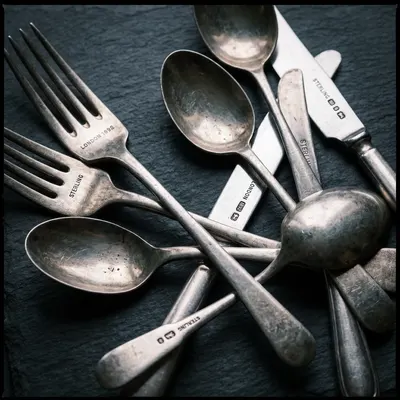
Sheffield-assayed flatware, knives, forks, spoons, ladles and serving pieces, is the single largest category of hallmarked silver passing through UK charity shops. Many estates contain a partial or complete set of Sheffield silver flatware, often kept in a fitted wooden canteen, often inherited from a parent or grandparent. When the estate is broken up, the canteen frequently goes to a charity shop.
A complete or partial set of Sheffield-hallmarked flatware can be worth substantially more than its metal-melt value, because the set has resale value as a set. A broken-up set, or a single fork, is valued on the silver content alone. The weights involved are larger than most volunteers expect: a sterling table fork or tablespoon typically weighs 60 g to 90 g, a dessert spoon 40 g to 60 g and a teaspoon 20 g to 30 g, so a part-set of forty pieces can hold two kilograms of sterling. One caveat: sterling-handled knives are usually 'loaded' with resin for balance, so a knife's weight is mostly filler rather than silver; forks and spoons are solid. The practical step on the sorting table is simply to keep any matched-pattern Sheffield flatware together, in the canteen if it has one. Do not split the set.
The big trap: Sheffield plate vs Sheffield sterling
This is the single most common confusion on the sorting table, and the one that costs charities the most when it goes wrong in either direction. Sheffield plate and Sheffield sterling are not the same thing.
- Sheffield sterling. Solid silver, hallmarked by the Sheffield Assay Office with a crown or rose, a lion passant, a date letter and a maker's mark. This is what the postal pile is for. It pays against the silver market.
- Sheffield plate. A sandwich of silver fused onto a copper core, invented in Sheffield in the 1740s. It is not solid silver and not hallmarked with the office marks. It can carry the maker's name, sometimes with a sun or a star, but never with the lion passant. On worn pieces the copper shows through as a pinkish tint on high points and edges, a tell the trade calls bleeding. It does not pay against the silver market, although genuine 18th and early-19th-century Sheffield plate can have antique value of its own, so photograph an old piece before pricing it for the floor.
- EPNS Sheffield. Electroplated nickel silver, made in Sheffield from the 1840s onwards. A microscopic layer of silver on a nickel-silver alloy base. Marked EPNS, EP, A1 or similar. It does not pay against the silver market.
The practical test for a volunteer is the lion passant. A walking lion in profile, stamped clearly, is the standard mark for English sterling silver. If the lion is there alongside a crown, a rose or any English office mark, the piece is sterling. If the marks include EPNS, EP, A1, BP, or simply a maker's name with no lion, the piece is plate and stays on the shop floor.
How to tell a sterling fork from an EPNS fork
Both look similar on the shelf. Both are heavy, both can be polished bright, and both can carry a Sheffield-related maker's name (the city had hundreds of cutlers and platers operating side by side). The differences sit in the marks, not in the look.
- 1. Turn the fork over and read the back of the handle. Sterling marks sit here, usually in a horizontal line of four small stamps.
- 2. Look for the lion passant. A walking lion in profile is the English sterling standard mark. If it is there, the fork is sterling.
- 3. Look for the office mark. A crown (pre-1975) or rose (1975 onwards) is Sheffield. A leopard's head is London. An anchor is Birmingham.
- 4. Check for EPNS or EP. These letters mean electroplated. The piece is silver-coated nickel and stays on the shop floor.
- 5. If in doubt, photo and ask. A clear photo of the back of the handle on WhatsApp 07944 014111 settles it in seconds.
Sheffield-assayed gold
Sheffield assays less gold than London or Birmingham, partly because the city's historical specialism was silver and steel, but Sheffield-hallmarked gold does turn up in donation piles. The rose (post-1975) sits alongside a 375, 585, 750 or 916 fineness number, a maker's mark and a date letter. The piece pays against the gold market in exactly the same way as a Birmingham or London piece. The office of assay is not a discount on the metal.
Sheffield-assayed gold wedding bands, signet rings and small chains all appear in UK donation streams, especially in donation piles from estates in Yorkshire, the East Midlands and the north of England. Same sorting rule applies: find the fineness number, recognise the office mark, set the piece aside in the gold-pile bag.
Common Sheffield-hallmarked items in donation piles
- Sterling flatware (forks, spoons, knives, ladles, serving pieces). The single largest category, often in a fitted canteen.
- Sterling salt cellars, pepper grinders and condiment sets. Often Victorian or Edwardian. Frequently boxed.
- Sterling napkin rings. Commonly engraved with a name or initials.
- Christening cups, tankards and small bowls. Often given as gifts, often inherited.
- Trophies and presentation pieces. Sheffield was the centre of UK trophy manufacture for much of the 20th century.
- Sheffield-assayed gold wedding bands and signet rings. Less common than Birmingham, but present in donation piles from the north of England.
What happens once a Sheffield-hallmarked piece is set aside
The shop manager or head-office contact sends a clear photo on WhatsApp or phone 07944 014111. We give an indicative figure on the day and send a free Royal Mail Special Delivery prepaid label, usually within 30 minutes during working hours. Royal Mail cover may be available up to £2,500 depending on the postal method and cover level used, and higher cover can be arranged on request before posting, which matters for a complete canteen or larger hollowware. The shop posts the parcel at any Post Office counter and keeps the receipt.
On arrival, each item is XRF-tested for purity, weighed on calibrated scales, and priced against the LBMA benchmark on the day of valuation. A written itemised offer goes back to the charity's head-office contact. If accepted, payment is sent to the charity's registered bank account by Faster Payments within one working hour of acceptance. Indicative figures move with the market; the firm offer is set only after the piece is inspected. If declined, every item is returned, free, tracked and signed for.
A 60-second briefing for a volunteer
If a new volunteer is joining the sorting table, this is the briefing that gets them useful on Sheffield-hallmarked pieces in a minute.
- 1. Look for a crown or a rose. Either is the Sheffield office mark.
- 2. Find the lion passant. A walking lion confirms sterling silver.
- 3. Read the date letter. A single letter in a shield, telling you the year.
- 4. Watch for EPNS or EP. These letters mean plated, not sterling. Stays on the shop floor.
- 5. Keep flatware sets together. A complete canteen is worth more as a set than as separate pieces.
Common questions
What does the rose on a UK hallmark mean?
It is the assay-office mark for Sheffield. The rose became the single Sheffield town mark for gold and silver in 1975, when the traditional Sheffield crown was retired. It does not on its own tell you the metal or the date.
What is the difference between Sheffield plate and Sheffield sterling?
Sheffield sterling is solid silver, hallmarked with the office mark, the lion passant, a date letter and a maker. Sheffield plate is silver fused onto a copper core, invented in Sheffield in the 1740s, and is not solid silver. Only sterling pays against the silver market.
How do I tell EPNS from sterling?
Look for the lion passant. A walking lion in profile on the back of the piece confirms English sterling. If the marks read EPNS, EP, A1, BP or similar, the piece is electroplated nickel silver and stays on the shop floor.
Should we keep a Sheffield flatware canteen together?
Yes. A complete or near-complete canteen has resale value as a set, above the silver-melt value of the individual pieces. Send a photo of the canteen lid and the marks on one fork on WhatsApp 07944 014111 before deciding.
A heavy fork is stamped with a Sheffield maker but no lion passant. Is it sterling?
No. A Sheffield maker name without a lion passant means the piece is electroplate or Sheffield plate, not sterling. The lion passant is the test.
Are Sheffield hallmarks worth less than London hallmarks?
No. The metal value is the same regardless of office. Some Sheffield makers carry an antique premium, but the office of assay does not change the underlying metal value.
What if we change our mind once we see the written offer?
Free tracked return of any item the charity chooses not to sell. No fees, no pressure, no part-accept clauses.
Request a free prepaid Royal Mail label
Tell us where to send it. The label arrives by email, usually within about 30 minutes during working hours. Requesting one commits you to nothing: you get a written offer after the XRF assay, and if you decline, your items come back to you free.
Would you rather ask a question first, or send a photo? Message us on WhatsApp . It is the fastest way to get a sense of what something is worth before you post anything.