The dealer’s notice, displayed under section 11 of the Hallmarking Act 1973
Section 11(1) of the Hallmarking Act 1973 requires every dealer in precious metals to keep the approved notice exhibited at all times, in a conspicuous position, in the part of their premises that the people they deal with are commonly admitted to. GoldPaid has no shop and no public premises, so the notice is displayed here and linked from the footer of every page on this site. It is reproduced exactly as supplied by the British Hallmarking Council, with no amendments, additions or deletions.
Dealer’s Notice, Hallmarking Act 1973
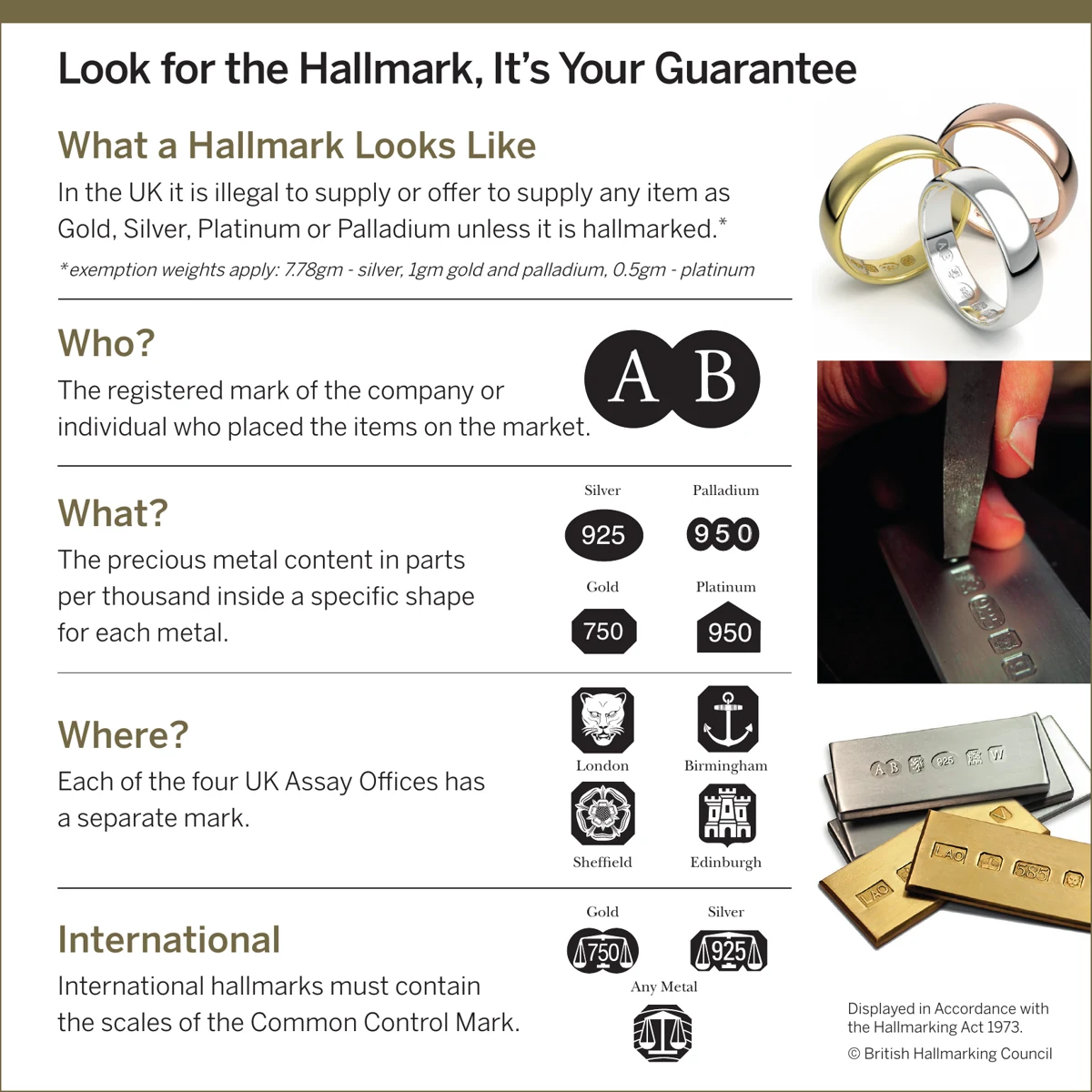
Look for the Hallmark, it’s your guarantee
What a Hallmark looks like
In the UK it is illegal to supply or offer to supply any item as gold, silver, platinum or palladium unless it is hallmarked.
Exemption weights apply:
- silver - 7.78 grams
- gold and palladium - 1 gram
- platinum - 0.5 grams
Who?
The registered mark of the company or individual who placed the items on the market.
What?
The precious metal content in parts per thousand inside a specific shape for each metal:
- gold - 750 parts per thousand
- silver - 925 parts per thousand
- platinum - 950 parts per thousand
- palladium - 950 parts per thousand
Where?
Each of the 4 UK Assay offices (Birmingham, Edinburgh, London and Sheffield) has a separate mark.
International
International hallmarks must contain the scales of the Common Control Mark.
Displayed in accordance with the Hallmarking Act 1973. Reproduced without amendment, addition or deletion. This is the British Hallmarking Council’s Digital Dealer’s Notice (Dealer’s Notice B, the version produced for online use), in the text-only rendering published on GOV.UK (last updated 27 January 2023; that GOV.UK page carries a withdrawal banner dated 30 April 2025 which relates to the closed HALO Award application form it sits under, not to the notice text). The canonical version is the artwork above, reproduced from the Digital Dealer’s Notice published by the Assay Office London (file dated 21 October 2021; the Council has not issued a version number for Notice B) and served here unaltered as a PDF. © British Hallmarking Council.
Why this notice appears on this website
Section 11 of the Hallmarking Act 1973 requires a dealer in precious metals to keep this notice exhibited at all times, in a conspicuous position. GoldPaid buys gold, silver, platinum and palladium articles from the public in the course of business, which makes GoldPaid a dealer under the Act. GoldPaid trades entirely by post and has no shop or public premises. The British Hallmarking Council’s published guidance on selling articles of precious metal on the internet states that, in the Council’s view, the premises for these purposes are the websites concerned, so the notice is exhibited here. GOV.UK’s guidance for businesses adds that online retail sites must prominently display explanatory information about the hallmark.
Points worth knowing
- The exemption weights in the notice apply to an article containing only one precious metal, of at least the minimum fineness set by the Act. Articles above those weights must be hallmarked.
- A hallmark applied by a UK assay office certifies the fineness of the metal. It is not proof of where an item was made, and it says nothing about the value of any stones set in it.
- Some items never needed a hallmark. The Act exempts coins that are or were current in the UK or any other territory, gold and silver articles of at least minimum fineness made before 1950 and not altered since, battered articles fit only to be remanufactured, and raw material or bullion, among others. An unmarked piece is not necessarily a fake, and we test rather than assume.
- GoldPaid is not an assay office and cannot hallmark anything. The four UK assay offices are Birmingham, Edinburgh, London and Sheffield. Our own testing is XRF analysis, which measures the metal content of an item; it is not a hallmark and does not replace one.
- If you have a concern about hallmarking, contact your local Trading Standards service or the British Hallmarking Council.
More on reading the marks on your own items is in our gold hallmark guide, and the difference between a hallmark and a laboratory test is set out in XRF versus hallmark versus acid. Everything outside the bordered notice above is GoldPaid’s own summary, offered as general information rather than legal advice.
What does a hallmark certify?
One thing, precisely. That an independent assay office tested the article and found it, in all its parts, to be of at least the standard of fineness shown by the fineness mark struck on it. Fineness is expressed in parts per thousand, so 750 means 750 parts of gold in every thousand parts of alloy, which is 18 carat.
A full modern UK hallmark has three compulsory marks. Everything else you may see beside them is optional and has been since 1999.
| Mark | What it tells you | Compulsory? |
|---|---|---|
| Sponsor’s mark | The registered mark of the company or individual who submitted the article, that is, who placed it on the market. Usually initials inside a shaped shield. | Yes |
| Fineness mark | The precious metal content in parts per thousand, set inside a shape that identifies which metal it is. | Yes |
| Assay office mark | Which of the UK offices tested and marked the article. | Yes |
| Traditional fineness symbol | The older pictorial standard mark, such as the lion passant for sterling silver or the crown formerly used on gold. | Optional since 1999 |
| Date letter | The year the article was hallmarked. The current cycle runs A for 2025, B for 2026, C for 2027 and on through K for 2034. | Optional since 1999 |
| Common Control Mark | The set of scales used on international Convention hallmarks, recognised by the countries that have signed the International Convention on Hallmarks, including the UK. | Optional |
Our gold hallmark guide works through where to find the marks on rings, chains, earrings and watch cases, and UK silver hallmarks decoded takes the silver row apart punch by punch, including the date letters and duty marks on antique pieces.
What does a hallmark not certify?
This is the part most people get wrong, and it matters if you are deciding what a piece is worth.
- Not where it was made. The Dealer’s Notice says it outright: a hallmark applied by a UK assay office is not proof of origin or place of manufacture of an item. A leopard’s head means London tested it, not that London made it.
- Not a value. Two articles can carry identical marks and be worth wildly different sums, because value follows weight, the market rate on the day, and in some cases the maker or the rarity. A sterling teaspoon and a sterling salver show the same standard mark.
- Not what is in the piece today. The mark records the metal as tested at the point it was submitted. Solder at a clasp, a later ring sizing, a replacement earring back or a decades-old repair can all be a different alloy from the body of the article.
- Not the age of the piece. The date letter tells you when the article was hallmarked, not when it was designed or worn, and it has been optional since 1999, so a modern piece may carry none at all.
- Not the stones. Hallmarking is a precious-metal regime. It says nothing about a diamond, a sapphire, a pearl or a synthetic stone set into the article.
- Not whether the piece is hollow or filled. Loaded candlesticks and weighted bases are hallmarked on the silver skin. The pitch or plaster inside is not silver and is not covered by the mark.
What are the hallmarking exemption weights?
Light articles do not have to be hallmarked. The exemption sits in Schedule 1, Part II, paragraph 12 of the Hallmarking Act 1973 and applies to an article containing only one precious metal, of at least minimum fineness, weighing less than the figure for that metal. Articles above these weights must be hallmarked before a trader may describe or supply them as that precious metal.
| Metal | Exemption weight | Minimum fineness | Fineness marks a UK office may apply |
|---|---|---|---|
| Gold | 1 gram | 375 | 375, 585, 750, 916, 990, 999 |
| Silver | 7.78 grams | 800 | 800, 925, 958, 999 |
| Platinum | 0.5 grams | 850 | 850, 900, 950, 999 |
| Palladium | 1 gram | 500 | 500, 950, 999 |
A 0.8 gram pair of gold studs, a 6 gram silver charm and a very light gold chain can all be perfectly genuine and perfectly unmarked. The exemption weights are the single most common innocent explanation for a missing hallmark, and they are the reason we test rather than assume.
Under the notice, the fineness mark is set inside a shape that identifies the metal: an oval for silver, an octagon for gold, a house-shaped surround for platinum, and three linked circles for palladium. Once you know the shapes you can tell the metal at a glance even when the number is worn.
Which UK assay offices are there, and what are their marks?
Four offices operate in the United Kingdom today. Each has its own town mark, and each of those marks appears on the dealer’s notice above.
| Assay office | Town mark |
|---|---|
| London | A leopard’s head |
| Birmingham | An anchor |
| Sheffield | A rose |
| Edinburgh | A castle |
Older pieces carry marks from offices that have since closed, Chester, Glasgow, Exeter, Newcastle, Norwich, York and Dublin among them. A closed-office mark is a dating clue, not a defect. If you are trying to date a piece from its date letter, you need the letter, the shape of the shield and the town mark together, because each office ran its own alphabet cycles. The UK date letter chart sets those out.
Is an unhallmarked item fake?
Usually not. There is a long list of entirely lawful reasons an item of real gold or silver carries no UK hallmark, and the Act itself sets most of them out in Schedule 1, Part II.
- It is under the exemption weight for its metal, as above.
- It is old. Gold and silver of at least minimum fineness manufactured before 1950, and not since improperly altered, is exempt. Platinum made before 1 January 1975 and palladium made before 1 January 2010 are exempt too, because those metals were brought into the regime on those dates.
- It is a coin. Any coin that is, or formerly was, current coin of the United Kingdom or any other territory is exempt. Sovereigns, Krugerrands and pre-decimal silver are never hallmarked.
- It is broken beyond use. A battered article fit only to be remanufactured is exempt, which covers a great many snapped chains and crushed rings.
- It is raw material. Bars, plate, sheet, foil, rod, wire, strip, tube and bullion are exempt, as is a manufactured article that is not substantially complete.
- It was never submitted here. Imported jewellery that never went to a UK office, and pieces bought abroad, often carry only a foreign or maker’s stamp.
- It is dental gold. Crowns, bridges and inlays are cast from dental alloy and are never sent for hallmarking.
- The mark has simply worn away, or sits on a section that was cut out during a repair or resizing.
Equally, a stamp is not a hallmark. A bare “925” or “750” punched by a manufacturer is a claim, not an independent test result, and plated goods are routinely stamped the same way. Marks such as EPNS, EP, A1, GP, GEP, HGE, GF and rolled gold are not hallmarks at all. If you want to work through it yourself, how to identify fake gold covers the at-home checks and where each one stops being reliable.
Does hallmarking law apply to me if I am selling my own jewellery?
No. The duties in the Hallmarking Act 1973 fall on dealers, meaning people acting in the course of a business or trade. Section 22(1) defines a dealer as a person engaged in the business of making, supplying, selling or exchanging articles of precious metal, or in other dealings in such articles. A private individual selling their own unhallmarked ring commits no offence, and there is nothing suspect about an unmarked family piece.
The duties do fall on GoldPaid. Buying second-hand precious metal from the public in the course of business is an “other dealing” in such articles, so we are a dealer, so section 11 applies to us, and so the notice above is displayed. We say that plainly because it is not something every postal buyer does.
Can GoldPaid apply a hallmark? No, and here is what we do instead
GoldPaid is a buyer of gold and silver by post. We are not a UK assay office, we cannot strike a hallmark, and nothing we issue is a hallmark or a substitute for one. Only London, Birmingham, Sheffield and Edinburgh may hallmark an article in the United Kingdom, and the word itself is reserved to them by the Act. If you need an authoritative ruling on a mark, those offices and your local Trading Standards service are the right route.
What we can do is measure. Every parcel is assayed by X-ray fluorescence spectrometry on arrival. XRF fires a low-energy X-ray at the item, reads the energies the atoms re-emit, and returns the elemental composition of the alloy in parts per thousand. It is non-destructive, so nothing is filed, scratched or acid-tested.
| Question | A UK hallmark | An XRF assay |
|---|---|---|
| Was this independently tested? | Yes, by an assay office, when it was submitted | Yes, by us, on the day it arrives |
| What is the metal actually made of now? | Not answered. The mark records the standard met at submission | Answered, as a full elemental breakdown of the alloy |
| Is the solder or a later repair a lower carat? | Not answered | Visible in multi-point readings |
| Is it plated over base metal? | Not answered, and plated goods are often stamped to look marked | Flagged where edge and face readings disagree |
| Does the item meet a legal UK standard? | Answered, that is the whole purpose of the mark | Not a legal determination. An XRF report is not a hallmark |
| What are the stones? | Not answered | Not answered. XRF reads metal, not gemstones |
The two things answer different questions, which is why we treat a hallmark as a useful starting point and the assay as the finding. You can read the method in full on how we value gold and silver, the science on XRF testing explained, and, if you want a written analysis report without selling anything, our XRF testing service is a separate paid service by post, with no obligation to sell.
What are the limits of this page?
This is a plain-English summary written by a gold buyer, not legal advice, and three things on it are less settled than the rest. We would rather say so.
- The website-as-premises position is the regulator’s view, not case law. The Hallmarking Act was drafted in 1973 and says nothing about the internet. The British Hallmarking Council’s published guidance states that in its view the premises for the purposes of the legislation are the websites on which the articles are advertised and sold, and that the site should display the prescribed notice prominently. We have found no court decision testing that. We display the notice because the cost of displaying it is nothing and the cost of being wrong is an offence.
- The Council’s wording is aimed at sites that sell. GoldPaid buys. The statutory definition of a dealer reaches “other dealings in” articles of precious metal, which is why we treat the duty as applying to us, but we have not found a published source addressing a buy-only postal service directly.
- Version currency. The notice reproduced above is the version published by the assay offices for online use at the date of review shown at the top of this page. The British Hallmarking Council may reissue it. If you are a trader relying on this page, download the current file from an assay office yourself rather than copying ours.
If you spot something on this page that is out of date or wrong, tell us and we will correct it. Getting a compliance page wrong is worse than not having one.
Sources
- Hallmarking Act 1973 (legislation.gov.uk), in particular section 11 on the dealer’s notice, section 22 on the meaning of “dealer” and minimum fineness, and Schedule 1 on permitted descriptions and exempted articles.
- Hallmarking: how businesses can comply with the law (GOV.UK guidance), which sets out the Dealers Notice A and Dealers Notice B requirements.
- Selling articles made of precious metals on the internet, British Hallmarking Council guidance published on GOV.UK, the source of the website-as-premises position.
- The British Hallmarking Council, and the four UK assay offices: London, Birmingham, Sheffield and Edinburgh.
- Business Companion, the official Trading Standards guidance service, for the display rules that apply when the notice is printed for use in a shop.
Statutory references checked 6 August 2026. Statements of law on this page are summaries of the sources listed and are not legal advice. Where a position is the regulator’s stated interpretation rather than statute, the page says so in the limits section above.
Common questions
What does a UK hallmark actually guarantee?
That an independent UK assay office tested the article and found it, in all its parts, to be at least the fineness shown by the fineness mark. That is the whole of the guarantee. It is not a guarantee of value, of age, of the quality of the workmanship, or of where the item was made. The Dealer’s Notice states it plainly: a hallmark applied by a UK assay office is not proof of origin or place of manufacture.
What weight of gold or silver has to be hallmarked in the UK?
Articles above 1 gram of gold, 7.78 grams of silver, 0.5 grams of platinum and 1 gram of palladium must be hallmarked before a trader may describe or supply them as that precious metal. The exemption in Schedule 1, Part II, paragraph 12 of the Hallmarking Act 1973 applies to an article containing only one precious metal, of at least minimum fineness, weighing less than the figure for that metal. Below the threshold, hallmarking is optional, which is why so many light chains, charms and stud earrings are legitimately unmarked.
Is it illegal to sell my own unhallmarked jewellery?
No. The Hallmarking Act 1973 places its duties on dealers acting in the course of a business or trade, not on a private individual selling their own property. You commit no offence by selling an unhallmarked ring, chain or bracelet that you own. GoldPaid XRF-tests every item on arrival, so an unmarked piece is valued on the metal actually measured in it rather than on what a stamp claims.
Does no hallmark mean my item is fake?
Often not. Items below the exemption weights never needed one. Gold and silver made before 1950 and not since improperly altered is exempt, as is platinum made before 1 January 1975 and palladium made before 1 January 2010. Current and former UK and foreign coins are exempt. So are battered articles fit only to be remanufactured, and raw material or bullion. Imported jewellery was often never submitted to a UK office, and decades of wear rub marks away. The only way to settle it is to measure the metal, which is what an XRF assay does.
Can GoldPaid hallmark my item, or tell me if a hallmark is genuine?
No, and we will not pretend otherwise. Only the four UK assay offices, London, Birmingham, Sheffield and Edinburgh, may apply a UK hallmark. GoldPaid is a buyer, not an assay office. What we can do is measure the elemental composition of your item by XRF and tell you whether that measurement is consistent with the mark stamped on it. If a mark looks wrong to us we will say so and explain why, and if you need an authoritative ruling the assay offices and your local Trading Standards service are the right route.
Which UK assay office marked my item?
Read the town mark. A leopard’s head is London, an anchor is Birmingham, a rose is Sheffield and a castle is Edinburgh. Those four are the only offices operating today. Marks from closed offices such as Chester, Glasgow, Exeter, Newcastle, Dublin and York turn up regularly on antique pieces and are a dating clue rather than a problem.
What is the Common Control Mark on my jewellery?
It is the international Convention hallmark, a set of scales alongside the fineness figure. The UK is a signatory to the International Convention on Hallmarks, so an article carrying a Convention hallmark struck by another signatory country is recognised here in the same way as a UK hallmark. It is a legitimate mark, not a fake, and you will see it on plenty of imported jewellery.
Why does a gold buyer with no shop display a dealer’s notice?
Because section 11 of the Hallmarking Act 1973 requires every dealer in precious metals to keep the approved notice exhibited at all times in a conspicuous position on their premises, and the British Hallmarking Council’s published view is that for internet dealings the website is the premises. GoldPaid has no shop and no public premises, so this page and the footer link on every route are how the notice is kept conspicuous.
Does the hallmark change what GoldPaid pays me?
It informs the conversation but it never sets the figure. Every item is XRF-assayed to confirm what the metal actually is, weighed to 0.01 of a gram, and priced at GoldPaid’s published per-gram rate for the confirmed purity on the day we assess it. Solder joints, sizings and later repairs are frequently a lower carat than the body of a piece, so the measured composition and the stamp do not always agree. You are paid for what is measured, and you see the itemised breakdown before you decide anything.
Not the question you had? The full GoldPaid FAQ covers the rest, from postal cover and ID checks to what happens if you decline the offer.
Related pages
- UK gold hallmark guide, how to read the marks
- UK silver hallmarks, decoded
- UK date letter chart
- How to identify fake gold
- XRF testing explained
- Hallmark lookup
- UK hallmark identification chart (A4 PDF)
- Paid XRF testing by post, with no obligation to sell
- How we value gold and silver
- How selling by post works, step by step
- Sell gold by post, UK-wide
- Sell silver by post